
Laodikeia Agora and Temples: Visitor Guide
A focused guide to Laodikeia agora and temples, covering the Syrian Goddess and Imperial Cult temples, layout, archaeology, route, and visit time on site.
Updated
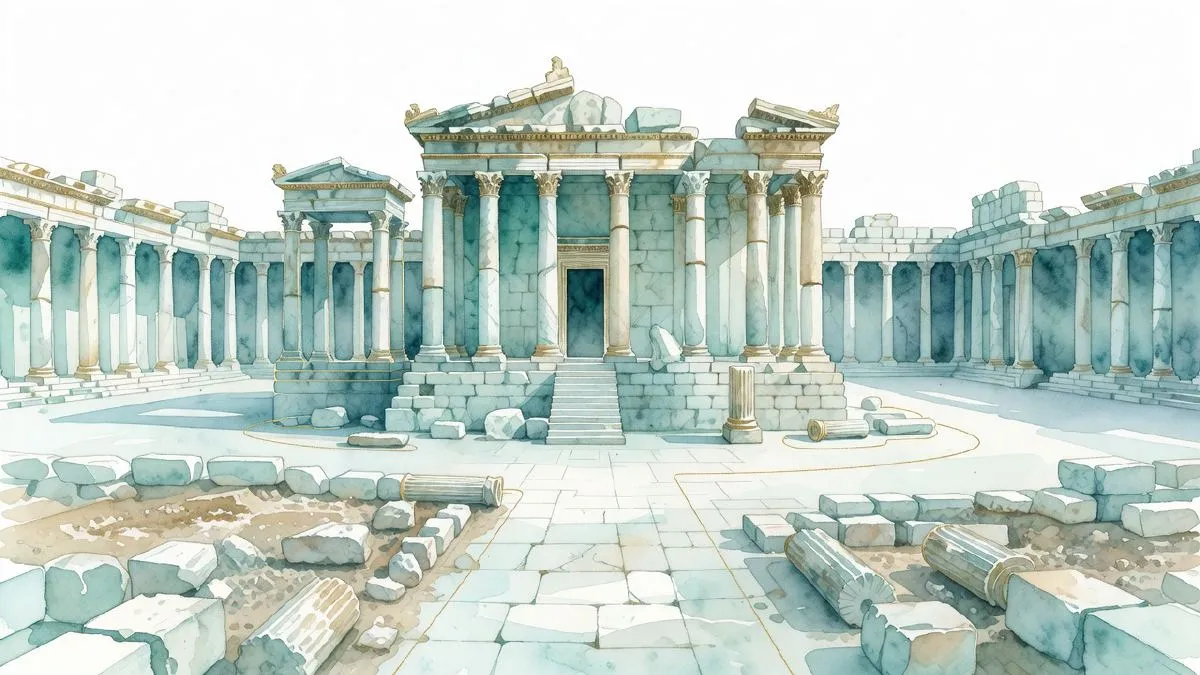
The Laodikeia agora and its nearby temples can be followed as one focused route in about 30 to 45 minutes. The agora occupies the centre of the excavated area, while the Syrian Goddess Temple and the Imperial Cult Temple show how commerce, religion, and Roman civic life met in the same part of the city. Much of the area remains under excavation, so the sections open to visitors may change during the 2026 season. The current access should be confirmed on the site entrance board. For 2026 conditions, kontrol edin the official site notices before travelling.
How is the Laodikeia agora laid out?
The agora sits close to the centre of the excavated area, near Sira Caddesi, also known as the main or Colonnaded Street. It follows a roughly square plan of about 110 by 110 metres and was framed on four sides by a roofed colonnade, or peristyle. The open central space was surrounded by the architectural setting of a public square rather than standing as an isolated courtyard.
Its first foundation belongs to the Hellenistic period, around the 3rd century BC. The agora was later expanded during the Roman period, particularly in the 1st and 2nd centuries AD. The surviving architectural pieces include column drums, capitals, paving fragments, and parts of the surrounding porticoes. Corinthian capitals are associated with the visible remains, although Ionic fragments have also been reported and the exact arrangement should be treated with care.
The agora had several connected functions. It was a commercial centre in a city known for textile production and banking, but it was also a place for public meetings and civic activity. Shops likely occupied parts of the portico interiors, while the central area could accommodate market activity, announcements, and gatherings. Its size reflects the role of Laodikeia as a wealthy urban centre, not simply the presence of a ceremonial monument.
Today, much of the central courtyard remains open earth and excavation work continues. The clearest way to understand the plan is to look from the edge of the square towards the surviving lines of columns and walls. The south and east porticoes provide the strongest sense of the agora’s perimeter. The west side leads towards other architectural remains, but those structures are outside the narrow agora and temple focus of this page.
For the wider setting of the site, the Laodikeia ancient city guide provides the general route and background. This page stays with the agora and the sanctuaries immediately connected to it.
Which temples are connected to the agora?
The principal temple associated with the agora is the Temple of the Syrian Goddess, located northeast of the square and close to the main street. It is generally connected with a Syrian goddess, possibly Atargatis or Derketis, although the identification is not completely certain. The goddess is associated with fertility and water cults, and the surviving evidence does not allow every aspect of the worship to be reconstructed with confidence.
Architecturally, the temple had a prostyle plan, with columns across its front, and stood on a raised podium. Corinthian elements are associated with the structure, although individual architectural details should be read together with the current archaeological interpretation. The podium, column bases, and scattered architectural blocks help visitors understand the temple’s elevation even where the upper structure is missing.
Parts of the Syrian Goddess Temple were restored during the 2020s. The reported completion of restoration work in 2023 must be verified for the 2026 season through the Ministry of Culture and Tourism or the site’s current notices. Kontrol edin the restoration status before visiting, since excavation and conservation work can alter both the route and the way individual remains are presented.
Southwest of the agora is the smaller Temple of the Imperial Cult. It is usually described as a tetrastyle building, meaning that its front had four columns. Marble blocks form part of the surviving remains. The temple was dedicated to the worship of Roman emperors and may belong to the period of Augustus or Tiberius, though the precise attribution should not be treated as certain without an on-site explanation.
The position of this temple is important. It stood near the commercial and civic centre, placing imperial loyalty within the same urban landscape as trade, public meetings, and local religious practice. Its smaller scale does not make it an incidental structure. The foundations and column fragments indicate a defined architectural unit, even though the original elevation is largely lost.
Other sanctuary remains around the agora are more fragmentary. Blocks and foundations have been associated with a possible Temple of Zeus, but that identification remains debated. An Asklepios cult site is also believed to have existed and is linked in the research literature with Laodikeia’s medical tradition. There is not enough visible evidence here to describe either sanctuary in detail, so they are best understood as possible parts of the wider religious landscape rather than complete monuments on the route.
What should you look for while walking between them?
The value of this short route comes from comparing the buildings rather than viewing each one separately. At the agora, the repeated lines of the porticoes show how a large public square was enclosed and organised. At the Syrian Goddess Temple, the raised podium and frontal arrangement create a more concentrated religious setting. At the Imperial Cult Temple, the smaller tetrastyle plan points to a different kind of public message, connected to the Roman imperial system.
The relationship between the agora and temples also helps explain Laodikeia’s urban structure. Commercial activity, civic meetings, and religious ceremonies were not placed in completely separate parts of the city. The sanctuaries stood close enough to the main routes and public square to participate in the daily movement of the city.
Some architectural pieces show signs of repair and reuse. Laodikeia was affected by a major earthquake in AD 60 and was subsequently restored. The surviving fragments should therefore not be read as belonging to a single untouched building phase. Different stones, repairs, and rebuilding periods can appear together, especially around the agora’s porticoes and the temple remains.
The identity of the temples is also part of the visitor experience. The Syrian Goddess Temple is often presented with a likely identification rather than an absolute one, while the Zeus attribution remains disputed. A guide or current site panel can help separate established evidence from scholarly interpretation. This is particularly useful when a column fragment or foundation is easy to mistake for a fully identified temple.
The route is uneven, with loose gravel, exposed stone, and broken architectural blocks. The central agora offers limited shade. Comfortable closed shoes make it easier to move between the surviving porticoes and temple remains without turning the visit into a rushed walk. The accessible areas can change during excavation, so the route visible on the day should take priority over any fixed map.
How much time is needed for this route?
A focused visit to the agora, the Syrian Goddess Temple, and the Imperial Cult Temple usually takes 30 to 45 minutes. The shorter end is enough for a general view of the plans and surviving columns. The longer end allows time to compare the structures, read the information panels, and pause for photographs around the column remains and the edges of the central courtyard.
Morning light can fall clearly across the surviving stonework, while late afternoon may offer a quieter atmosphere depending on the day’s visitor pattern. There is little shade around the agora, so the practical difference between these times is more important than a fixed photographic rule. Visitor density and access can vary during the 2026 excavation season; kontrol edin the current site conditions before setting a precise timetable.
From Pamukkale, Laodikeia is about 6 kilometres away and roughly 10 minutes by car in normal conditions. Denizli dolmuş services also provide a public transport option, although the stop, frequency, and walking connection should be confirmed locally for 2026. The guide to getting to Pamukkale explains the wider transport connections used by visitors arriving in the area.
What is the main point of the agora and temple route?
The agora explains Laodikeia’s public and commercial life through its scale, square plan, and surrounding colonnades. The temples add the religious and political dimension: the Syrian Goddess Temple reflects a local or regional cult tradition whose exact identity is still discussed, while the Imperial Cult Temple places Roman authority beside the civic centre. The possible Zeus and Asklepios remains show that the religious landscape was broader than the two better-defined structures.
A focused visit does not require covering every building in Laodikeia. With 30 to 45 minutes, there is enough time to read the agora’s layout, compare the two principal temples, and notice how excavation and restoration shape what can be seen. Keep the visit centred on the square, the Syrian Goddess Temple, and the Imperial Cult Temple, and treat the fragmentary sanctuaries as evidence of a wider setting rather than separate stops.
For the broader site plan and arrival context, continue with the Laodikeia ancient city guide.
Where these places are
Distances from the travertine entrance. Tap a marker to open its guide.
All places on this map
- The Antique Pool (Cleopatra's Pool)
- The travertine terraces of Pamukkale
- Hierapolis Ancient City (Guide coming soon) · 0.7 km from the terraces
- Karahayıt: the red thermal springs · 5.1 km from the terraces
- Laodikeia: the ruined city across the valley · 9.9 km from the terraces
- Denizli: the working city next to Pamukkale · 15.9 km from the terraces
- Tripolis: a Roman city on the Meander with almost no one in it (Guide coming soon) · 19.8 km from the terraces
- Kaklık Cave: Pamukkale underground · 24.2 km from the terraces
- The Çal vineyard route: high-altitude wine an hour from Pamukkale (Guide coming soon) · 29.6 km from the terraces
Guided tours and day trips in Pamukkale
Skip the planning. Pick a theme below to compare guided tours, balloon rides and day-trip packages, many with instant confirmation and free cancellation.
- Pamukkale + Hierapolis day tour
- Hot air balloon ride
- Sunset tour
- Day trip from İzmir
- Day trip from Antalya
- Cleopatra antique pool
Coming out this way?How to get there →